Germany national football team vs scotland national football team lineups have become the talk of the football world as both teams faced off in the opening match of Euro 2024.
The host nation Germany entered the tournament with high hopes after an underwhelming performance in their last World Cup appearance.
Under the guidance of coach Julian Nagelsmann, the German squad showed promising signs of improvement during their warm-up matches, giving fans reason to believe in their potential success.
Meanwhile, Scotland arrived at the tournament as underdogs but with a fighting spirit that has defined their qualification campaign.
Steve Clarke’s men faced early challenges with key injuries forcing tactical adjustments before the big opener.
The electric atmosphere at the Allianz Arena set the stage for an exciting clash between these two football nations with contrasting styles and expectations.
Germany National Football Team Vs Scotland National Football Team Lineups
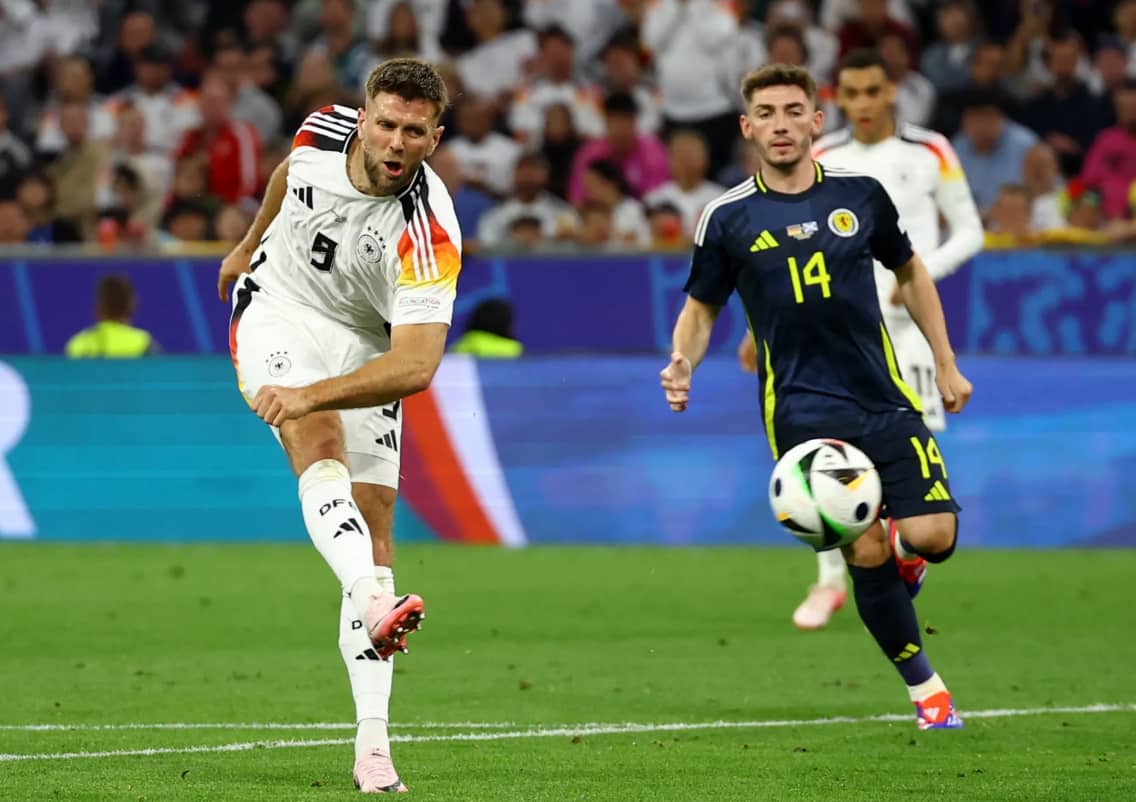
Germany’s technical brilliance led by stars like Jamal Musiala, Florian Wirtz, and veteran Toni Kroos faced off against Scotland’s determined defensive approach and counter-attacking strategy.
The lineups for both teams reflected their respective philosophies and game plans for this crucial opening match of the tournament.
Germany Starting XI
The German starting lineup showcased a blend of experienced veterans and exciting young talent, carefully selected by coach Julian Nagelsmann for the Euro 2024 opener.
The formation was designed to maximize their possession-based style while maintaining defensive stability.
| No. | Player | Position | Substituted |
|---|---|---|---|
| 1 | Manuel Neuer | GK | |
| 6 | Joshua Kimmich | RB | |
| 4 | Jonathan Tah | CB | 62′ |
| 2 | Antonio Rüdiger | CB | |
| 18 | Maximilian Mittelstädt | LB | |
| 23 | Robert Andrich | CM | 46′ |
| 8 | Toni Kroos | CM | 81′ |
| 10 | Jamal Musiala | RW | 74′ |
| 21 | İlkay Gündoğan (c) | AM | |
| 17 | Florian Wirtz | LW | 63′ |
| 7 | Kai Havertz | CF | 63′ |
Nagelsmann’s selection demonstrated his faith in the squad that performed well during friendly matches. The back four provided solid defensive coverage while allowing for overlapping runs from the fullbacks.
The midfield trio of Andrich, Kroos, and Gündoğan offered perfect balance with defensive stability and creative passing. Up front, the dynamic trio of Musiala, Wirtz, and Havertz created numerous attacking opportunities with their movement and technical skills.
Germany Substitutions
The German bench provided Nagelsmann with quality options to adjust his team’s approach as the match progressed. Each substitution was made with clear tactical purposes in mind.
| No. | Player | Position | Substituted In |
|---|---|---|---|
| 15 | Nico Schlotterbeck | CB | 62′ |
| 19 | Leroy Sané | RW | 63′ |
| 9 | Niclas Füllkrug | CF | 63′ |
| 13 | Thomas Müller | RW | 74′ |
| 14 | Emre Can | CM | 81′ |
The substitutions reflected Germany’s game management strategy. Schlotterbeck came in to reinforce the defense, while Sané and Füllkrug were introduced to provide fresh attacking impetus.
The experienced Thomas Müller replaced Musiala to help maintain possession in the final stages, and Emre Can’s introduction for Kroos helped secure the midfield as the game approached its conclusion.
Scotland Starting XI
Steve Clarke’s Scotland lineup revealed a pragmatic approach designed to contain Germany’s attacking threat while looking to exploit counter-attacking opportunities. The team was organized in a defensive 3-5-2 formation.
| No. | Player | Position | Substituted |
|---|---|---|---|
| 1 | Angus Gunn | GK | |
| 2 | Anthony Ralston | RWB | 48′ |
| 13 | Jack Hendry | CB | |
| 15 | Ryan Porteous | CB | 44′ |
| 6 | Kieran Tierney | CB | 77′ |
| 3 | Andrew Robertson (c) | LWB | |
| 4 | Scott McTominay | CM | |
| 8 | Callum McGregor | CM | 67′ |
| 7 | John McGinn | RW | 67′ |
| 11 | Ryan Christie | LW | 82′ |
| 10 | Ché Adams | CF | 46′ |
Scotland’s selection highlighted their defensive priorities with three center-backs and wing-backs who could drop deeper when needed.
The midfield was anchored by McTominay and McGregor, providing energy and work rate in the central areas.
Captain Robertson provided leadership from his left wing-back position, while the front pairing of Christie and Adams offered pace and movement to trouble the German defense when opportunities arose.
Scotland Substitutions
Scotland’s bench was called upon frequently during the match, with injury concerns and tactical adjustments requiring Steve Clarke to use his substitutes effectively.
| No. | Player | Position | Substituted In |
|---|---|---|---|
| 5 | Grant Hanley | CB | 46′ |
| 14 | Billy Gilmour | CM | 67′ |
| 23 | Kenny McLean | CM | 67′ |
| 26 | Scott McKenna | CB | 77′ |
| 9 | Lawrence Shankland | CF | 82′ |
The Scottish substitutions were partly forced due to fitness issues. Hanley replaced Adams at halftime to shore up the defense, while Gilmour and McLean came on to provide fresh legs in midfield.
McKenna was introduced as Tierney tired, and Shankland offered a late attacking option as Scotland looked for a way back into the game.
Neuer
Manuel Neuer remains an imposing figure in goal for Germany despite his advancing years in the sport. His leadership from the back continues to be vital for the German national team.
In the match against Scotland, Neuer demonstrated why he’s still considered among the elite goalkeepers in world football.
Neuer’s game is characterized by:
- Exceptional command of his penalty area
- Precise distribution with both feet
- Quick decision-making when rushing off his line
- Vocal organization of the defense in front of him
Despite a minor error in Germany’s warm-up match against Greece, coach Nagelsmann maintained his faith in the experienced goalkeeper.
This decision proved wise as Neuer’s presence provided stability and confidence to the German backline against Scotland.
Neuer’s role extends beyond just shot-stopping. He functions as an additional field player in Germany’s build-up play, often positioning himself high off his line to provide a passing option for defenders under pressure.
This aspect of his game allows Germany to maintain possession effectively and build attacks from the back with numerical superiority.
At 38 years old, Neuer’s experience is invaluable for the German squad, especially in major tournaments where composure and mental strength are as important as technical ability.
His communication with the defensive unit helps maintain their shape and reduces opportunities for opposing attackers.
Kimmich
Joshua Kimmich stands out as one of Germany’s most versatile and reliable performers. His ability to excel in multiple positions makes him an indispensable asset for the national team. Against Scotland, Kimmich demonstrated his quality from the right-back position.
Kimmich’s key attributes include:
- Tactical intelligence and positional awareness
- Exceptional passing range and vision
- Defensive discipline combined with attacking threat
- Natural leadership qualities on the pitch
Often compared to the legendary Philipp Lahm, Kimmich has established himself as an elite defender whose influence extends across multiple areas of the pitch.
While he has frequently played as a holding midfielder for his club Bayern Munich, Nagelsmann opted to utilize him at right-back for this tournament opener.
Kimmich’s versatility allows him to seamlessly transition between defensive duties and attacking contributions.
His crossing ability provides an additional creative outlet for Germany, while his defensive positioning enables him to nullify threats on his flank.
The partnership between Kimmich and players ahead of him on the right side creates overloads that are difficult for opponents to handle.
His understanding with teammates allows for fluid positional exchanges that maintain Germany’s attacking rhythm while preserving defensive solidity.
Rudiger
Antonio Rüdiger brings physical presence and aggressive defending to Germany’s backline. His commanding style makes him a formidable obstacle for opposing forwards.
Throughout the match against Scotland, Rüdiger showcased his defensive capabilities with confident performances in aerial duels and one-on-one situations.
Rüdiger’s strengths as a defender include:
- Physical dominance in duels
- Excellent recovery pace to handle counter-attacks
- Strong aerial ability both defensively and from set-pieces
- Comfort on the ball under pressure
The center-back has grown into a leadership role within the German squad, providing vocal organization and ensuring the defensive line maintains proper spacing and positioning.
His experience at club level with Real Madrid has further enhanced his ability to perform on the biggest stages.
Rüdiger’s aggressive style occasionally leads to confrontations, but this intensity sets the tone for Germany’s defensive approach. His willingness to engage attackers early disrupts the rhythm of opposition build-up play and forces turnovers in advantageous positions.
While primarily known for his defensive abilities, Rüdiger also contributes to Germany’s attacking phases with precise forward passing and occasional forays into advanced positions during set-pieces.
His versatility allows him to cover multiple defensive roles if required by tactical adjustments during matches.
Tah
Jonathan Tah has emerged as a reliable defensive presence for Germany, combining physical attributes with technical quality. His partnership with Rüdiger at the heart of defense provided solid protection for Neuer against Scotland’s attacking threats.
Tah’s defensive qualities include:
- Impressive physical presence at 6’5″ (1.95m)
- Good reading of the game
- Composure in possession
- Developing leadership abilities
The Bayer Leverkusen defender has benefited from his club’s successful season under Xabi Alonso, developing greater tactical awareness and confidence in possession.
These improvements have translated to his performances for the national team, earning him a starting role in Nagelsmann’s lineup.
Though substituted after 62 minutes against Scotland, Tah’s contribution during his time on the pitch helped establish Germany’s defensive dominance in the match.
His replacement by Nico Schlotterbeck appeared to be a tactical decision rather than a response to poor performance.
Tah’s development curve suggests he will be an important figure for Germany beyond this tournament.
At 28 years old, he is entering his prime years as a central defender and possesses the attributes needed to maintain a high level of performance in international competition.
Mittelstadt
Maximilian Mittelstädt represents one of the newer faces in Germany’s squad, earning his place through consistent performances at club level.
His selection at left-back for the tournament opener highlighted Nagelsmann’s faith in his abilities despite limited international experience.
Mittelstädt’s qualities include:
- Balanced attacking and defensive contributions
- Good crossing ability from wide areas
- Positional discipline in defensive phases
- Energy to cover the entire left flank
The Stuttgart defender’s rise to prominence has been somewhat unexpected, with his form at club level compelling Nagelsmann to include him in the national team setup.
His assist during Germany’s warm-up match against Hungary demonstrated his ability to contribute to the attack while maintaining defensive responsibilities.
Against Scotland, Mittelstädt provided width on the left side, allowing Wirtz to drift inside into more central positions.
This movement created space for overlapping runs and crossing opportunities, adding another dimension to Germany’s attacking play.
While less experienced than many of his teammates, Mittelstädt showed composure under the pressure of a tournament opener.
His selection over more established options speaks to Nagelsmann’s trust in his ability to handle the defensive demands while contributing to Germany’s attacking phases.
Kroos
Toni Kroos embodies the technical excellence and control that has long been associated with German football.
His return from international retirement specifically for this tournament underscored his importance to the national team’s midfield structure and overall play.
Kroos’ midfield mastery is characterized by:
- Extraordinary passing accuracy over all distances
- Exceptional press resistance and ability to retain possession
- Intelligent positional play without the ball
- Set-piece delivery of the highest quality
Operating alongside Andrich in a deeper midfield role against Scotland, Kroos controlled the tempo of Germany’s play with his measured passing and calm decision-making.
His ability to switch play with precise long-range passes stretched the Scottish defense and created spaces for Germany’s more attack-minded players.
Euro 2024 likely represents Kroos’ final tournament for Germany, with the midfielder announcing his intention to retire from all football at the conclusion of the competition.
This adds emotional significance to his performances as he seeks to end his illustrious career on a high note.
Kroos’ replacement by Emre Can in the 81st minute was likely a management decision to preserve his energy for future matches while protecting a comfortable lead.
His influence during his time on the pitch set the foundation for Germany’s dominant performance.
Andrich
Robert Andrich provides the physical presence and defensive awareness that balances Germany’s midfield.
His inclusion alongside Kroos created a complementary partnership that allowed Germany to dominate possession while maintaining defensive security.
Andrich’s key qualities include:
- Strong tackling ability and defensive anticipation
- Physical presence in midfield duels
- Intelligent positional play to intercept opposition passes
- Underrated passing range to progress play forward
The Bayer Leverkusen midfielder has drawn comparisons to Sami Khedira for his combination of work rate, physicality, and tactical intelligence.
His ability to read the game and anticipate threats before they develop makes him valuable in disrupting opposition attacks and protecting the defensive line.
Andrich’s substitution at halftime suggests a tactical adjustment by Nagelsmann rather than a response to poor performance.
His contribution during the first half helped establish Germany’s control in midfield areas, laying the groundwork for their dominant performance.
While perhaps less heralded than some of his teammates, Andrich’s role in the German system is crucial for balancing the team’s approach.
His willingness to perform the unglamorous defensive work allows more creative players like Kroos, Gündoğan, and the attacking trio to express themselves with greater freedom.
Musiala
Jamal Musiala represents the exciting future of German football with his exceptional technical ability and creativity. His performance against Scotland demonstrated why he is considered one of the most talented young players in world football.
Musiala’s standout qualities include:
- Extraordinary close control and dribbling ability
- Quick decision-making in the final third
- Spatial awareness to find pockets between defensive lines
- Composed finishing in scoring positions
The Bayern Munich youngster terrorized Scotland’s defense with his direct running and close control in tight spaces.
His ability to beat defenders in one-on-one situations created numerous dangerous situations and disrupted Scotland’s defensive organization.
Despite his youth (21 years old), Musiala has already established himself as a key figure in Germany’s attack.
His decision to represent Germany at senior level after playing youth football for England has proven beneficial for the German national team, providing them with a creative spark that can unlock organized defenses.
Musiala’s substitution in the 74th minute for Thomas Müller allowed him to receive deserved recognition from the home crowd while preserving his energy for upcoming matches.
His performance set a high standard for the remainder of the tournament and reinforced his status as one of Germany’s most important attacking players.
Gundogan
İlkay Gündoğan captains Germany with a combination of technical excellence and tactical intelligence.
His role as the most advanced midfielder against Scotland showcased his ability to connect midfield and attack effectively while providing goal threat with his late runs into the box.
Gündoğan’s strengths include:
- Excellent timing of runs into scoring positions
- Technical security in possession
- Intelligent movement between defensive lines
- Leadership qualities on and off the pitch
The captain’s experience at the highest level with Manchester City and Barcelona has prepared him well for the pressures of leading Germany at a home tournament.
His composure in possession helped maintain Germany’s control of the match rhythm against Scotland.
Gündoğan will be determined to improve his tournament record with Germany, having experienced disappointment in previous major competitions.
As one of the senior players in the squad, his influence extends beyond his on-field contributions to include mentorship of younger teammates and setting professional standards.
His relationship with Kroos in midfield provides Germany with exceptional technical quality in central areas.
Their understanding allows for fluid positional exchanges that create passing angles and maintain possession even under pressure from opposition pressing.
Wirtz
Florian Wirtz enters Euro 2024 as one of Germany’s most exciting attacking talents following an outstanding season with Bayer Leverkusen.
His inclusion in the starting lineup against Scotland highlighted Nagelsmann’s confidence in his creative abilities despite his youth.
Wirtz’s exceptional qualities include:
- Creative vision to spot and execute defense-splitting passes
- Close control in tight spaces
- Acceleration to beat defenders
- Composed finishing when presented with scoring opportunities
Operating primarily from the left but with freedom to drift inside, Wirtz combined effectively with Gündoğan and Musiala to create a fluid attacking unit that consistently troubled Scotland’s defense.
His understanding with fellow young star Musiala suggests a bright future for Germany’s creative department.
At just 21 years old, Wirtz has already established himself as one of the Bundesliga’s premier attackers.
His contribution to Leverkusen’s unbeaten league campaign under Xabi Alonso demonstrated his ability to perform consistently at a high level – a quality that will be crucial for Germany’s tournament aspirations.
Wirtz’s substitution after 63 minutes allowed Leroy Sané to enter the game with fresh legs against tiring defenders.
The depth of talent available to Nagelsmann in these attacking positions represents a significant advantage as the tournament progresses.
FAQs
- Who coached the German national team during Euro 2024?
Julian Nagelsmann coached the German national team during Euro 2024. He took over the national team after a period coaching Bayern Munich and implemented a tactical approach that emphasized possession and creative attacking play while maintaining defensive solidity. Nagelsmann focused on integrating young talents like Musiala and Wirtz with experienced players such as Kroos and Neuer.
- What formation did Germany use against Scotland?
Germany employed a 4-2-3-1 formation against Scotland, with Neuer in goal; Kimmich, Tah, Rüdiger, and Mittelstädt in defense; Kroos and Andrich as holding midfielders; Musiala, Gündoğan, and Wirtz as the attacking trio behind lone striker Havertz. This formation allowed Germany to control possession through their midfield while providing width through their fullbacks.
- Who captained the Scotland team in the Euro 2024 opener?
Andrew Robertson captained Scotland in their Euro 2024 opener against Germany. The Liverpool left-back provided leadership from his position on the left side of Scotland’s formation and attempted to lead by example with his work rate and defensive contributions against Germany’s potent attack.
- How did Scotland set up tactically against Germany?
Scotland utilized a 3-5-2 formation that sometimes resembled a 5-3-2 when defending deeply. This approach prioritized defensive solidity with three center-backs (Hendry, Porteous, and Tierney) protected by wing-backs (Ralston and Robertson) who could drop deeper when needed. The midfield trio of McTominay, McGregor, and McGinn looked to disrupt Germany’s rhythm while supporting counter-attacks.
- What injury issues did Scotland face before the match?
Scotland suffered a significant setback when Lyndon Dykes was ruled out of the tournament through injury shortly before it began. This forced Steve Clarke to adjust his attacking plans, with Ché Adams starting as the central striker against Germany supported by Ryan Christie. The injury disruption continued during the match with Ryan Porteous needing to be substituted in the 44th minute.
- Who were the standout performers for Germany?
Jamal Musiala was particularly impressive for Germany, creating numerous dangerous situations with his dribbling ability and quick feet in tight spaces. Toni Kroos controlled the tempo of the game from midfield with his passing range and composure under pressure. Ilkay Gündoğan provided leadership and creative influence as captain, while Florian Wirtz showcased his talent with dangerous attacking moments.
Also Check:
- Argentina National Football Team Vs Canada Men’s National Soccer Team Lineups
- Argentina National Football Team Vs Colombia National Football Team Lineups
- Portugal National Football Team Vs Chile National Football Team Lineups
- Chile National Football Team Vs Argentina National Football Team Lineups
Conclusion:
The germany national football team vs scotland national football team lineups revealed much about both teams’ approaches to Euro 2024.
Germany’s selection demonstrated confidence and clarity in Nagelsmann’s vision, blending experienced players like Neuer, Kroos, and Rüdiger with exciting young talents such as Musiala and Wirtz.
This balance of youth and experience proved effective as Germany controlled the match through possession and technical quality while maintaining defensive organization.
Scotland’s lineup reflected the pragmatic approach of Steve Clarke, prioritizing defensive solidity against a superior opponent while looking to capitalize on counter-attacking opportunities.
Despite the early setback of losing Lyndon Dykes to injury before the tournament, Scotland showed resilience and fighting spirit characteristic of their qualification campaign.
The contrast in playing styles and squad depth was evident throughout the match, with Germany able to introduce quality substitutes like Sané, Füllkrug, and Müller as the game progressed.
Scotland’s substitutions were more reactive, often forced by injury concerns or the need to adjust to Germany’s dominance.
For Germany, this opening performance provided encouragement for their tournament prospects, suggesting they have moved beyond the disappointments of recent international competitions.
The fluid attacking play between Musiala, Wirtz, and Gündoğan created numerous dangerous situations, while the midfield control exerted by Kroos and Andrich established a platform for dominance.
Scotland will take valuable lessons from this challenging opener as they look ahead to their remaining group matches.
The experience gained against one of the tournament favorites should help prepare them for upcoming contests where they may find more opportunities to impose their own game plan.
As Euro 2024 progresses, both teams will continue to evolve their lineups and tactical approaches based on the lessons learned from this opening encounter.
Germany has set a high standard with their performance, while Scotland has gained important tournament experience that will serve them well in their quest to advance from the group stage.